Using Jokers: Jokers can be used to make any set of three or more tiles. There is no limit to the number of jokers you can use. Jokers can never be called or be used for a set of only one or two tiles (singles and pairs). (Technically, in a Real game, if you discard a Joker and misname it, someone can call it for Mah Jongg). Jokers are always safe to discard in JLMahJongg. This also means “Singles and Pairs” hands can never use jokers. This is part of the reason singles and pairs hands are higher value (harder) and don’t score double the card value for Jokerless (they are always Jokerless).
Each hand’s base value is shown on the card. You also can’t call a tile for any “Singles and Pairs” hand unless it is the last tile needed for Mah Jongg (you always need at least 3 in a set to call a tile unless for Mah Jongg). On a touch screen device and using Auto-Done, be careful not to accidentally discard a joker by touching it. The game may require you to hit the “Done” button if you want to discard a joker.
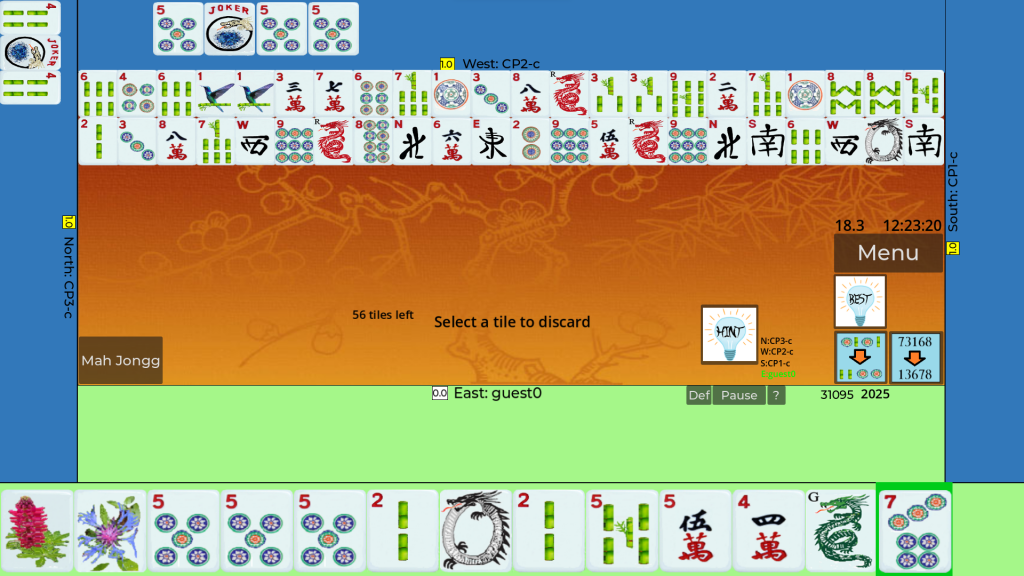
Joker Exchanges: Jokers that are eXposed (shown) can be exchanged for the tile they are being used as by players during their turn. A player’s turn starts when they draw or successfully call a tile. The turn ends when they discard a tile or call Mah Jongg. A joker can be exchanged if you have the tile it is being used as. For example, in Figure 8 someone could exchange an exposed joker during their turn for a 4 bam or 5 dot tile they have. You can, and usually should, exchange your own jokers. However, you might want to wait and exchange your joker for Mah Jongg (Finesse Move, see below). The primary player can exchange a joker when they have the matching tile by clicking on the joker to be exchanged (or touching it on a touch screen). The game does not tell you if there is a joker you can exchange. Hovering the mouse on a joker shows how it is being used. On touch displays, touching a joker shows how it is being used. To show the joker again, touch somewhere else on the display.
The pamphlet “Mah Jongg Made Easy” is NMJL’s guide on the official NMJL rules. Note that I believe there are confusing and/or incorrect information about a “Finesse.” Based on queries on the internet, reviewing the pamphlet, and information from Mah Jongg Facebook groups. A Finesse is when you intentionally hold on to a tile that you could exchange for a Joker and wait to exchange it just before you call Mah Jongg. “Mah Jongg Made Easy” says a Finesse is when you exchange for a Joker with a “tile from one’s own hand.” I believe “tile from one’s own hand” originally said or meant using a tile you did not just draw. You can’t exchange a Joker using a tile from someone else’s hand; that does not make sense. “Mah Jongg Made Easy” Joker rule #7 says that it has to be a “Joker from their own rack,” but I think this is incorrect and is a misinterpretation of “tile from one’s own hand.” It does not make sense to restrict a Finesse to only exchanging a Joker on your own rack. It appears that a Finesse originally was restricted to the opposite; you needed to exchange for a Joker on someone else’s rack. Otherwise, you are just rearranging the tiles you already have.
In terms of JLMahJongg scoring, if any Joker exchange is the last move before calling Mah Jongg, it is considered self-picked and scores double from all players; whether or not it is called it a Finesse Move. JLMahJongg only calls it a Finesse move if the tile used for the Joker exchange is not the last tile drawn from the wall.